
The 5 Homes Every Entertaining Home Must Have
A deep-dive guide for families that want a home designed around the people they love and the experiences they never want to stop having.
There is a certain kind of home that people never want to leave.
You know the one. You pull into the driveway and feel it before you even walk through the door, something about this place is different. Inside, the rooms are beautiful, yes, but more than that, they feel purposeful. The kitchen flows effortlessly into the living spaces. The outdoor area draws everyone outside without a second thought. The lighting shifts from bright and energizing in the afternoon to warm and intimate by evening. The house feels like it was built for exactly the life being lived inside it.
That kind of home doesn’t happen by accident.
It doesn’t happen because someone selected expensive finishes or splurged on the right appliances. It happens because, from the earliest stages of design, someone asked the right questions: How does this family actually live? Who do they love to have over? Where does the evening naturally flow? What does Sunday morning look like here? What does a holiday dinner for forty people look like in this space?
At Adeas Interior Design, those questions are where every project begins. Because the homes we design aren’t just beautiful spaces — they’re immersive experiences built around the specific people who will live and love and gather inside them.
If you’re planning a custom home or a full-home renovation, and entertaining is central to how you live… whether that means hosting holidays for extended family, Saturday dinners for your closest friends, impromptu lake weekends, or charity events in your backyard, then this guide is for you.
Because there are five rooms that will make or break your entertaining home. Get them right, and every gathering becomes effortless. Get them wrong, and you’ll spend years feeling like your home is working against you instead of for you.
We’re going to walk you through all five. Not with vague inspiration or surface-level suggestions, but with the strategic, specific thinking we apply to every project we take on. The kind of thinking that turns an expensive house into an extraordinary home.
We’ve been leading luxury residential design projects for over a decade. We have designed kitchens that host holiday dinners for sixty and primary suites that feel like a five-star resort. We’ve helped clients avoid $80,000 mistakes and specified materials that will look as beautiful in thirty years as they do today. Everything we’re sharing here comes from that experience. Consider this your insider’s guide to designing a home you will love for life.
The homes we design aren’t just beautiful spaces, they’re immersive experiences built around the specific people who will live and love and gather inside them.
Room One: The Kitchen : The Room That Runs the Show
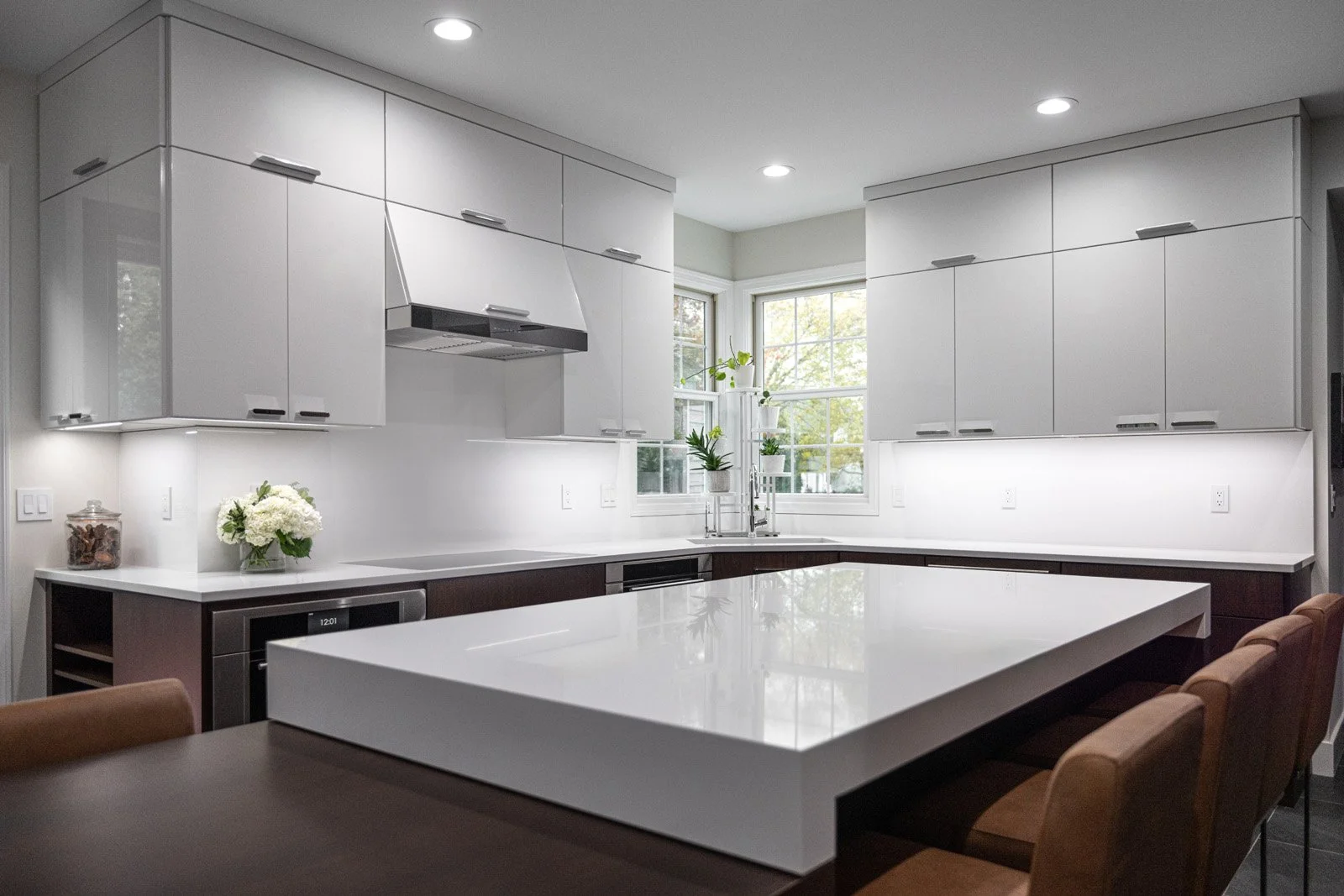
Let’s start here, because the kitchen is where every entertaining home either earns its reputation or quietly undermines it.
There is a persistent myth about kitchen design that we encounter on nearly every project, and it goes something like this: a beautiful kitchen is a functional kitchen. If the finishes are exquisite, if the appliances are top-of-the-line, if the island is generously sized, the kitchen will work.
It won’t. Not necessarily.
We’ve walked through kitchens in multi-million-dollar homes that fail completely as entertaining spaces because no one thought strategically about how the room would actually be used. The single island creates a bottleneck the moment more than two people are cooking. The refrigerator is tucked in a corner that forces guests to invade the cooking zone every time they want a drink. The seating is limited to four bar stools that nobody is comfortable in for more than twenty minutes. The layout works beautifully for a quiet Tuesday morning and completely falls apart on a Saturday night with fourteen people in the room.
This is what we mean when we say that luxury design must be both beautiful and functional. The two are not in conflict — when done right, they are inseparable. And in the kitchen more than anywhere else, function is what determines whether your home is the one everyone wants to gather in.
The Two-Zone Strategy
For clients who entertain regularly, we almost always recommend designing around a two-zone kitchen concept: a working zone and a gathering zone.
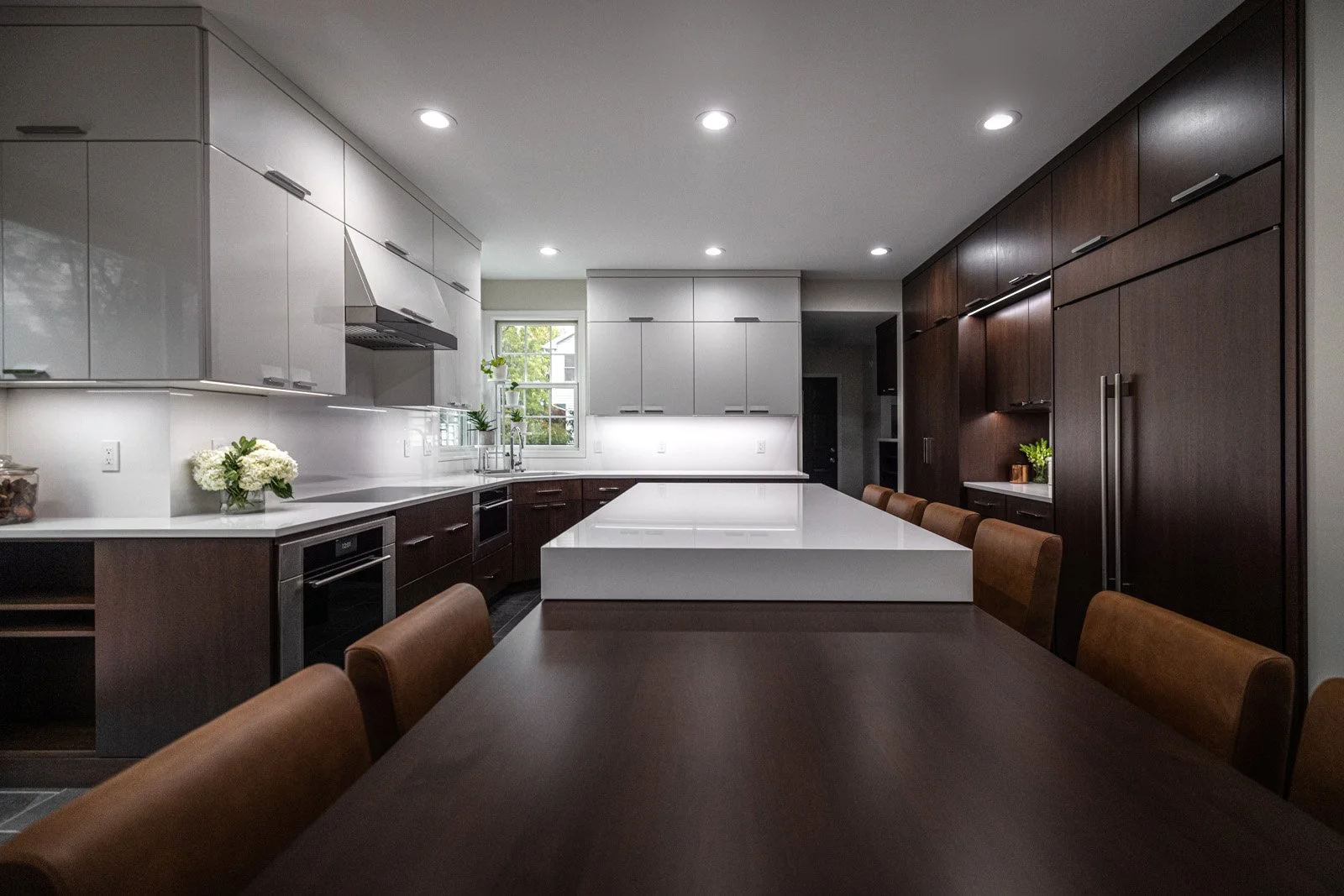
The working zone is where the cooking happens. It’s organized around the classic work triangle, refrigerator, sink, range, but extended and refined for a high-performance kitchen. This is the chef’s domain, and when you have guests over, it needs to function independently from the social activity happening around it.
Adequate clearances matter enormously here: we design for a minimum of 48 inches between islands and perimeter runs so two people can work comfortably without colliding. We think through every step of the cooking process, where does someone stand to prep vegetables? Where does the finished dish rest before it goes to the table? Where does the dirty pan go?... and we design for those moments specifically.
The gathering zone is where your guests land. It’s typically anchored by a second island or a generous peninsula, with seating for six to eight people. This is where people set their drinks down, where the kids pull up a barstool to talk while dinner is being made, where the real conversation happens while the host is still at the range. It’s the gravitational center of the open-plan space. It keeps guests connected to the host without putting them underfoot.
When these two zones are designed in relationship to each other, with thoughtful sightlines, intentional clearances, and strategic flow between them, the kitchen becomes the heart of the home in the truest sense. The host never disappears into another room. The cooking is part of the event.
The Catering Kitchen: The Feature Most People Discover Too Late
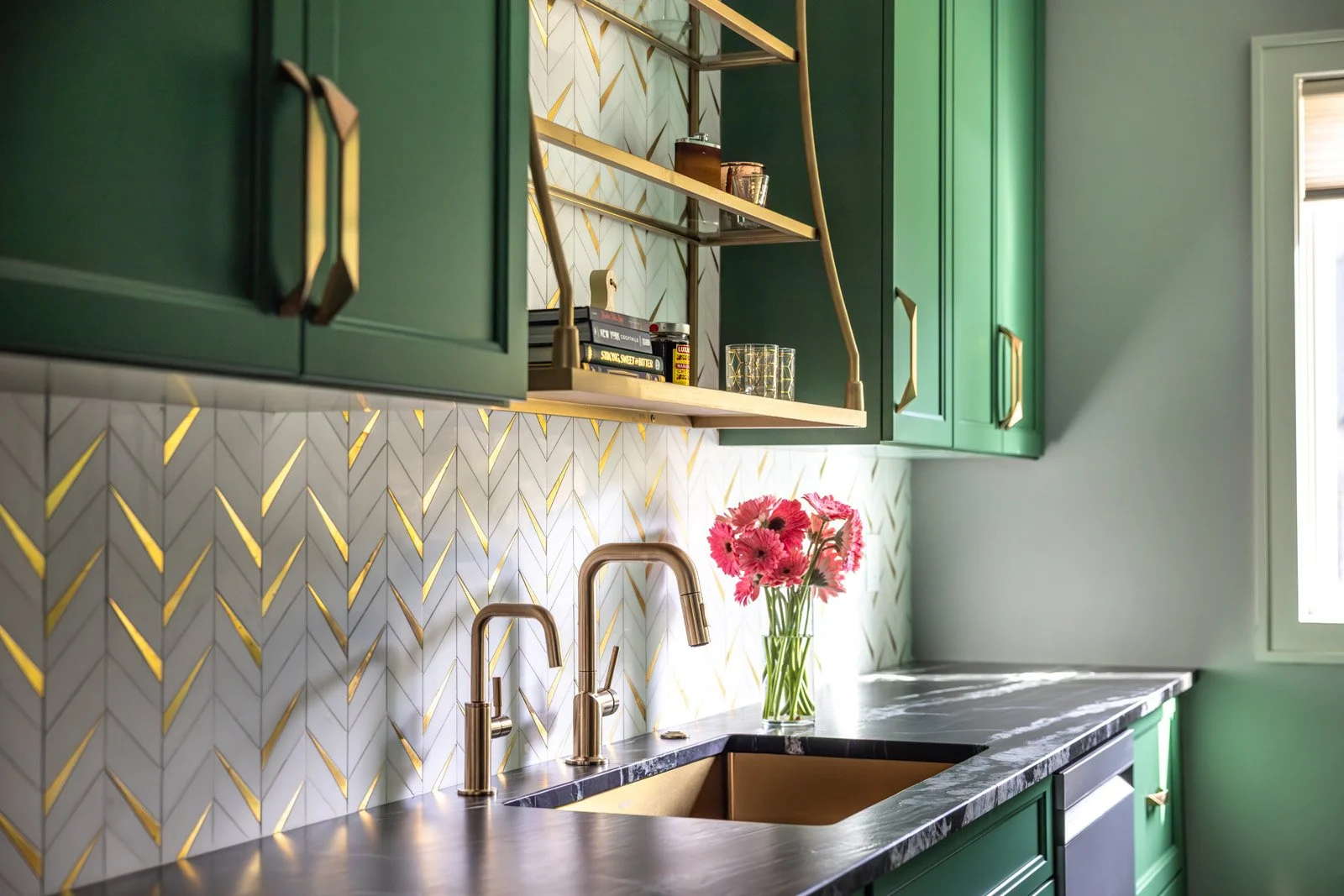
For clients who entertain at real scale (holiday dinners for fifty, regular dinner parties that require serious production, families who always have people over and value having the mess completely contained) we strongly recommend a catering kitchen or scullery.
This is the single feature we recommend most consistently that clients initially resist and later call the best decision they made.
The concept is straightforward: a secondary, utilitarian kitchen space, often concealed behind a pocket door or a dedicated hallway from the main kitchen, where the real preparation work happens. A second sink. Additional refrigeration. Counter space for staging. A place where caterers can work efficiently, where the dirty dishes disappear, where the chaotic production behind a beautiful dinner party is completely invisible to your guests.
The main kitchen stays immaculate. Your guests see only the finished result. And you are not spending the entire evening managing the mess on the island.
It is consistently described by our clients who have it as among the best investments they made in their home. We recommend it because we have seen, on project after project, what happens when a serious entertaining home doesn’t have one.
Materials That Work as Hard as They Look
A kitchen designed for real use needs materials that perform at the level they look. This is an area where we consistently protect clients from costly mistakes, because the wrong material in the wrong application will betray you within five years.
Countertops: Quartzite or engineered quartz for the primary cooking and prep surfaces. We love the beauty of real marble, but with the caveat that we also want to walk thru the steps of etch protection, sealants and maintenance, and the additional costs those incur (typically an additional 20% of the cost of your stone to get it properly protected).
Cabinetry: Full-extension, soft-close drawers on every single drawer. Full-overlay doors. Inset cabinetry is beautiful but unforgiving, it requires exceptional installation quality and we only specify it with cabinetmakers whose work we have personally inspected. Never compromise on drawer hardware. The tactile experience of a well-made kitchen is felt ten times a day.
Flooring: Large-format porcelain tile that reads as stone, fewer grout lines, dramatically easier maintenance, and genuine performance in the heavy-use zone of a kitchen that sees daily cooking, wet swimsuits, sandy feet, and everything else life delivers. Or engineered hardwood in species with a Janka hardness rating above 1200 for clients who want the warmth of wood.
Appliances: Professional-grade ranges and refrigeration are worth every penny. We specify Sub-Zero, Wolf, Thermador, Miele, and La Cornue for clients who actually cook, not because they are the most expensive options, but because they perform at the level a serious kitchen demands and they last decades rather than years.
The kitchen is the room your guests will stand in for the entire evening. It needs to look extraordinary and work flawlessly. We will never let you compromise on either.
Room Two: The Great Room: Where Everyone Lands
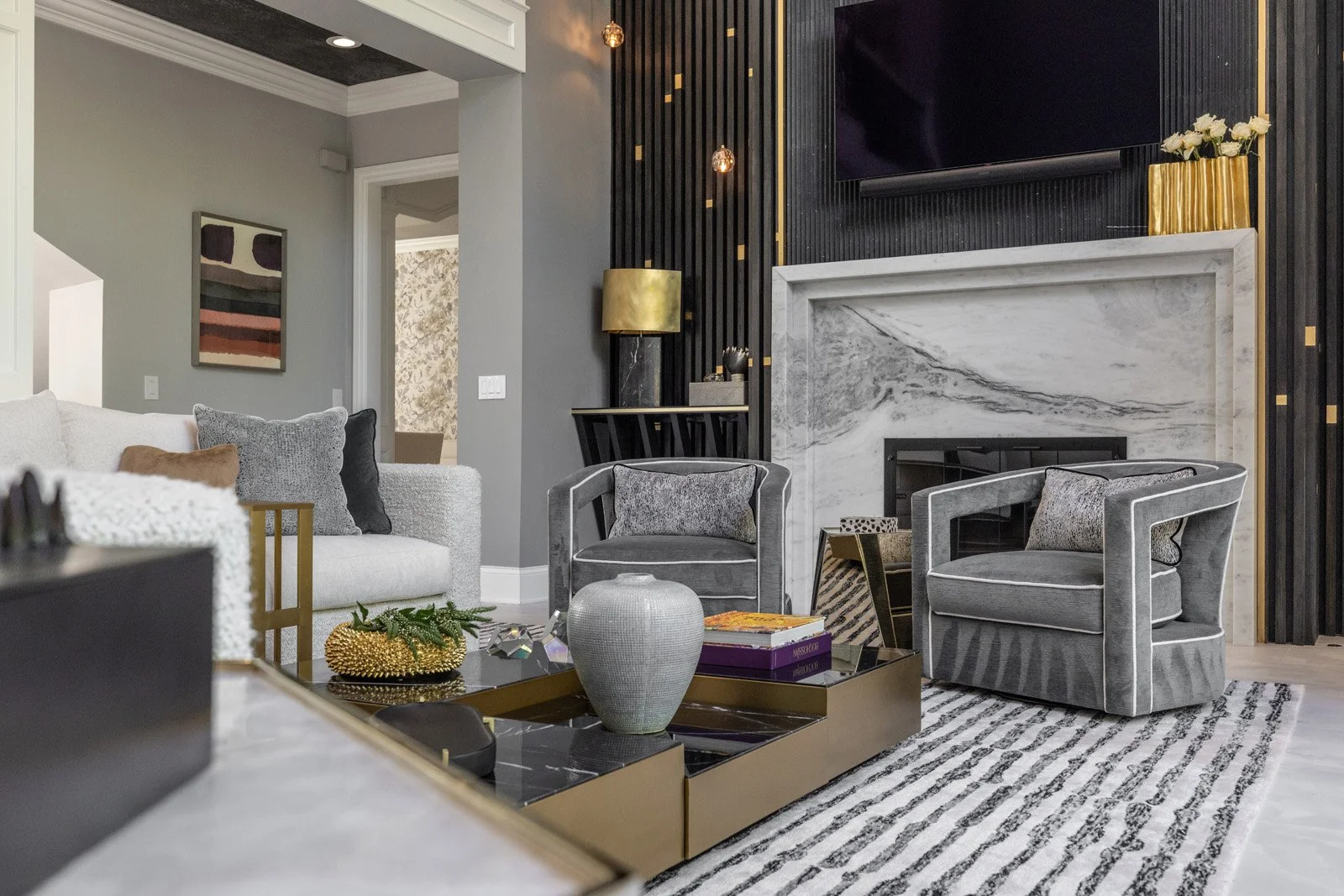
The great room is the living room, family room, and gathering space all in one, and for entertaining families, it is the room that holds every gathering together. Done right, it is the room that makes people sink into a sofa and think: I could stay here all night. Done wrong, it is a beautiful room that nobody actually uses.
We have seen this more times than we care to count: a stunning great room with museum-quality art, a $25,000 custom rug, and lighting that photographs beautifully, and it is completely non-functional for the family living inside it. The furniture is arranged in a way that makes conversation nearly impossible. The seating accommodates six people comfortably and becomes awkward at eight. There is nowhere obvious to set a drink down. The room says “don’t touch anything” when it should say “stay awhile.”
Livable luxury is a standard we hold ourselves to on every single project, and nowhere is that balance more critical than the great room. This is not a showroom. It is the heart of your home.
Designing for the Actual Number of People
For entertaining families, we design seating to accommodate a minimum of fourteen to eighteen people in a single great room conversation grouping. We know that sounds like a lot. It isn’t, when you think about what the holidays actually look like in your home.
The anchor piece is always a generously scaled sectional or a primary sofa grouping, not the eight-foot sofa that photographs beautifully in a showroom and seats four adults in reality. We specify custom sectionals, often 130 to 150 inches or larger, in performance fabrics that accommodate eight to ten people in the primary seating zone.
We then layer additional seating across the room: occasional chairs that can be pulled into the conversation, upholstered benches that seat two each, accent ottomans that function as additional seating when the room is at capacity. Every piece has a specific purpose. The arrangement is not decorative, it is orchestrated to pull people together and create natural conversation groupings that work whether there are four people in the room or forty.
The coffee table is always generous: 60 to 72 inches minimum for a primary seating group, because a coffee table is not decorative in an entertaining home. It is where drinks are set, where appetizers land, where the board game gets played on Sunday afternoon, and where the kids do homework on a Tuesday evening. It needs to earn its place.
The Performance Fabric Conversation
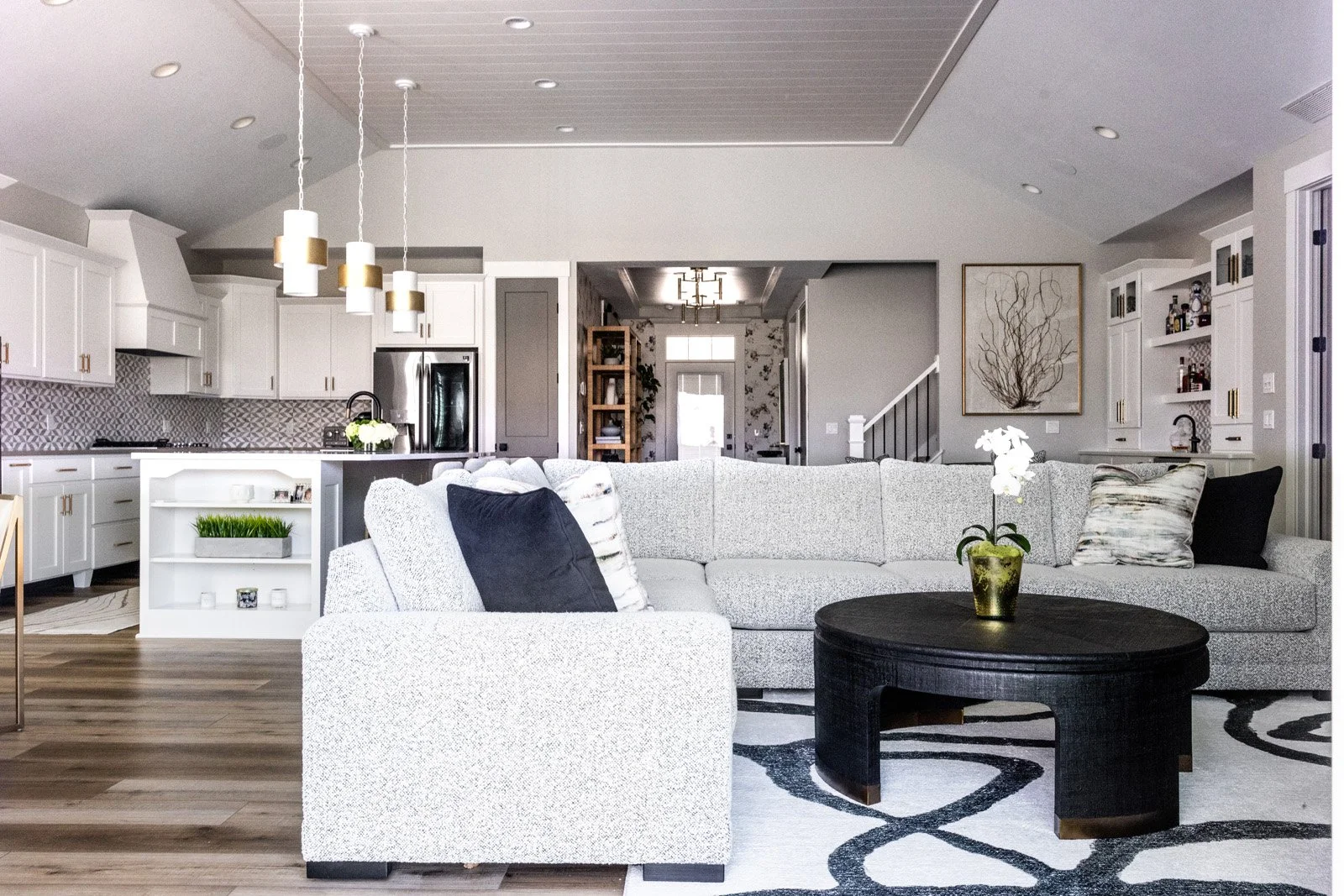
This is a conversation we have on every project, and we never skip it, because the wrong fabric choice in a great room that hosts grandchildren, lake weekends, and regular dinner parties will betray you within three years.
Performance fabrics have evolved remarkably in the past decade. The options we specify today: Crypton, Sunbrella, and a curated selection of high-performance wovens from the best textile houses in the industry. They look and feel indistinguishable from their non-performance counterparts. The velvet reads as velvet. The linen reads as linen. The difference is that when your grandchild spills an entire glass of grape juice on the sofa, you blot it up and move on with your evening.
We specify performance fabrics across the primary seating in virtually every entertaining home we design. We do not consider this a compromise. We consider it intelligent design, the kind of decision that protects a significant investment and preserves the beauty of a space for decades rather than years.
Lighting: The Single Detail That Transforms a Space
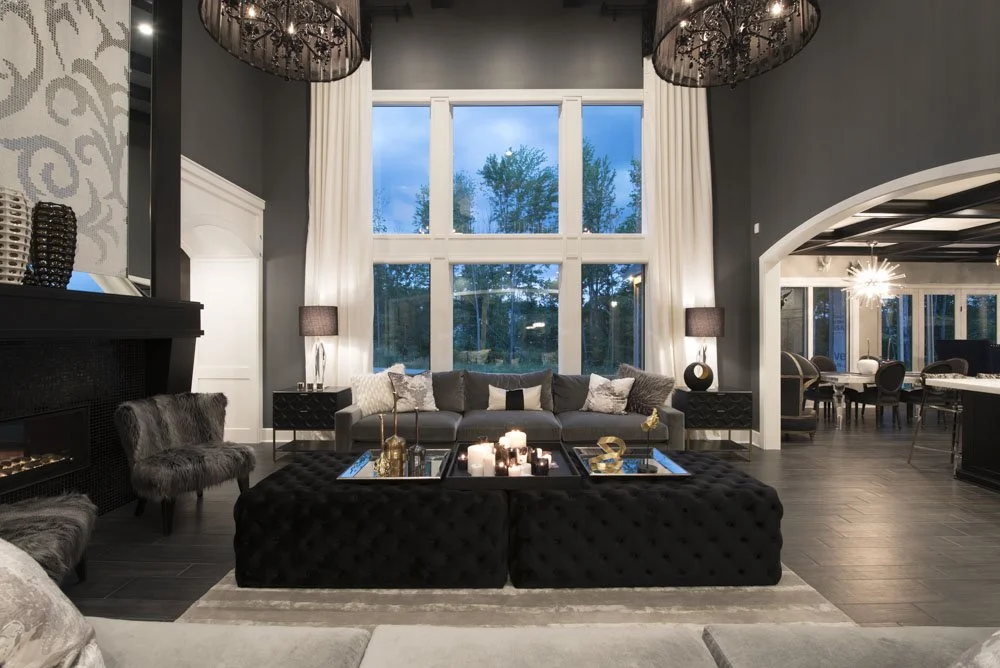
The great room needs to work in multiple modes across the course of a single day: bright and energizing in the morning, functional and clear in the afternoon, warm and intimate in the evening when guests arrive.
This requires layered lighting designed from the beginning of the project, not added as an afterthought. We design every great room with three distinct layers:
Ambient lighting: General overhead illumination that lights the room evenly. In great rooms, this is often a combination of recessed lighting and a statement chandelier or pendant that anchors the seating grouping. Every ambient circuit goes on a dimmer, always, without exception.
Accent lighting: Directional fixtures that highlight architectural elements, artwork, and objects of significance. Picture lights, adjustable recessed fixtures, and integrated cabinetry lighting all fall into this category. Accent lighting is what gives a room depth, warmth, and visual complexity.
Decorative lighting: The statement pieces (the chandelier, the pendant cluster, the sculptural floor lamp) that contribute to the room’s visual character. These fixtures are jewelry. They earn their place aesthetically, not functionally.
And then we put it all on a smart control system, programmed scenes for morning, afternoon, evening, and entertaining, so that shifting the room from daytime to dinner party is a single touch. This is the kind of detail that makes a home feel effortless to live in. It is also the kind of detail that is virtually impossible to retrofit once construction is complete. It must be planned from the beginning.
Livable luxury is a standard we hold ourselves to on every project. The great room is not a showroom. It is the heart of your home, and it must work as beautifully as it looks.
Room Three: The Powder Bath: The Room That Sets the Tone
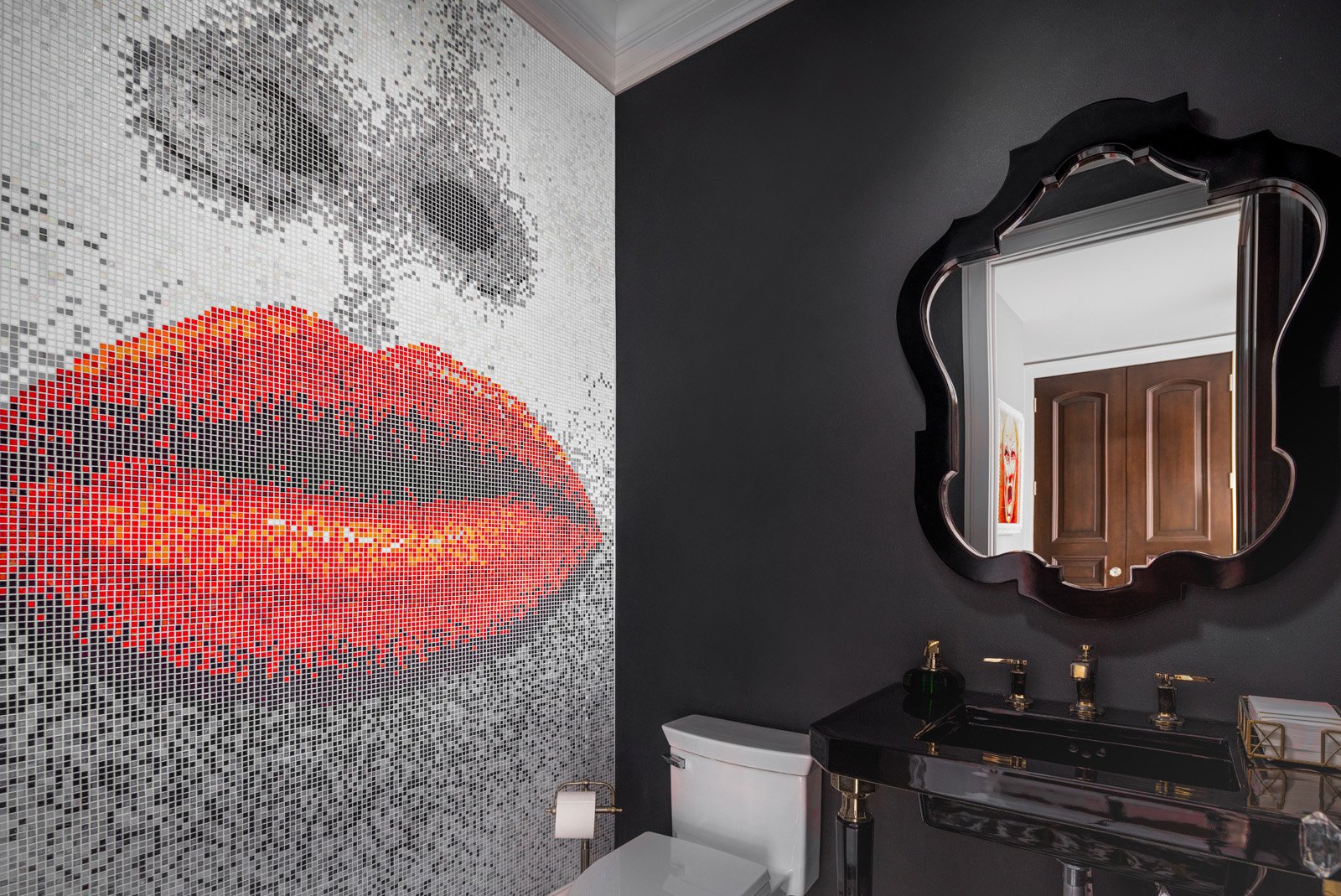
Here is something that surprises most clients when we tell them: the powder bath is one of the most important rooms in an entertaining home, and it is consistently the room where we recommend going bold and spending more than feels rational.
Think about what the powder bath actually does. Every single guest who comes to your home will spend time in that room. It is simultaneously completely private and completely public, a room your guests experience alone, up close, without distraction. There is no conversation to fill the space, no view to draw the eye. It is just the room.
A powder bath that is beautiful in a surprising, unexpected, deeply specific way tells your guests more about your taste and your commitment to quality than almost anything else in the house. And a powder bath that is merely nice (fine tile, a pretty faucet, a mirror from a showroom) is a missed opportunity that your guests will feel even if they cannot articulate why.
This is the room where we are most likely to recommend the bold, unexpected, “only possible in this specific home” design choice. Hand-painted de Gournay wallpaper. A sculptural vessel sink in onyx. Grasscloth from floor to ceiling in a color that makes the room feel like the interior of a jewel box. A custom mirror that took six weeks to source and is unlike anything your guests have seen before.
The Design Philosophy: Small Room, Maximum Impact
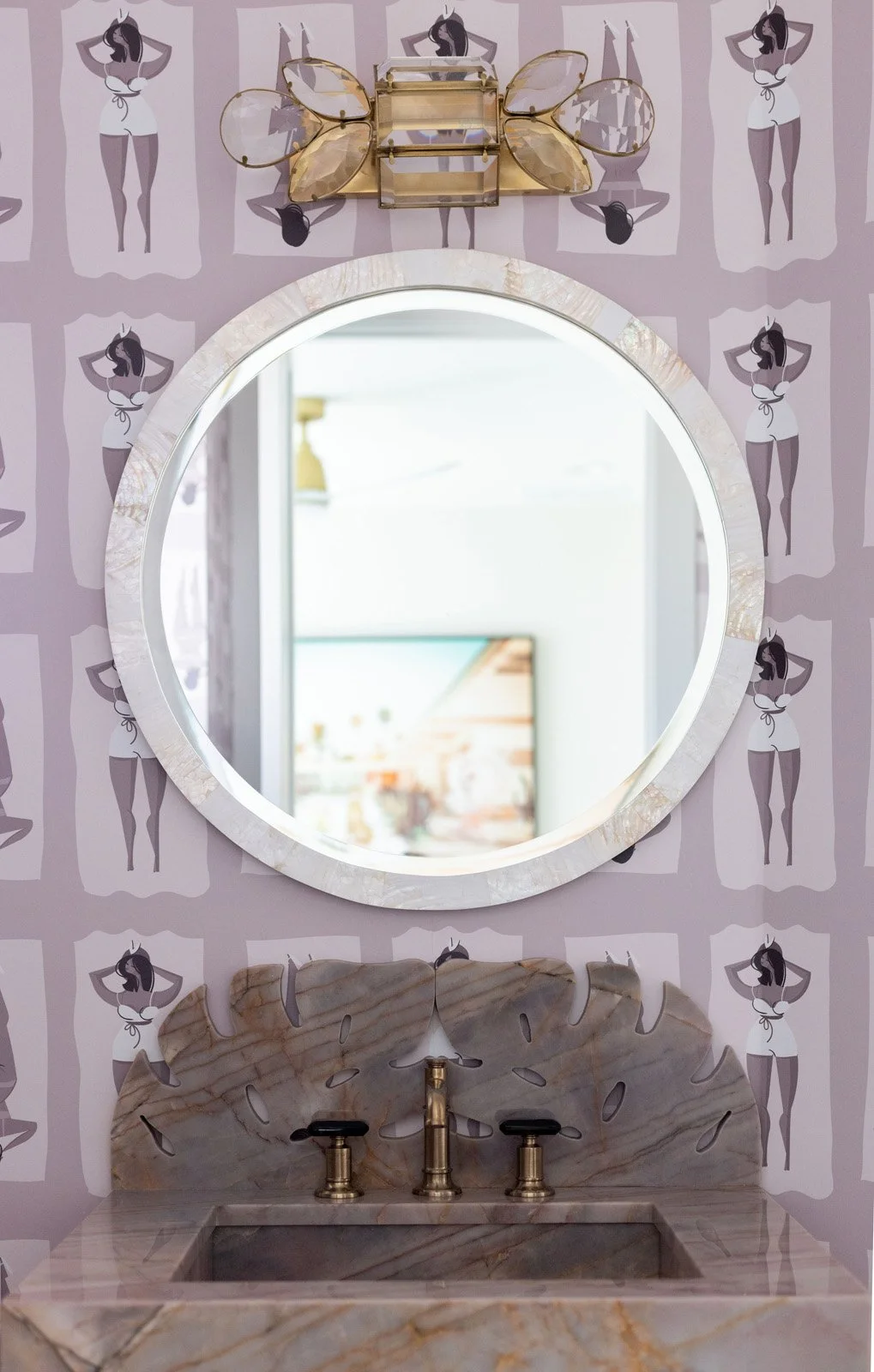
Because the powder bath is small, every single decision is amplified. There is no neutral. The wallpaper covers five square feet of wall space, not five hundred, which means you can afford the hand-painted paper you could never justify in the dining room. The floor tile is three square feet, not three hundred, which means you can specify the hand-cut Moroccan zellige or the book-matched marble slab that would be cost-prohibitive at scale.
We approach powder bath design as an opportunity to be decisive and daring in a way that is completely contained. The boldest choice in the house should often live here. A few principles we apply:
Wallcovering: This is the room where wallpaper is not an accent, it is the statement. We look for papers with depth, movement, and specificity: botanical prints, abstract textures, hand-painted scenery, geometric lacquers. The paper should make the room feel like an experience, not a backdrop.
Lighting: Powder baths are almost universally under-lit, and it shows. We specify wall sconces flanking the mirror at eye height — never a single overhead fixture, which casts unflattering shadows, plus a statement overhead piece that contributes to the room’s character. The combination creates even, flattering light and visual drama simultaneously.
The fixture as sculpture: The faucet, the towel ring, the toilet paper holder, in a powder bath, these are objects your guests look at from six inches away. We source hardware with the same intentionality we bring to furniture. Unlacquered brass that will patina beautifully. Hand-forged iron. Custom pieces from specialty artisans when the design calls for it.
Fragrance: This detail costs almost nothing and is remembered by everyone. A beautiful candle, a curated diffuser, fresh flowers when you’re entertaining. The powder bath should engage every sense, not just the visual.
We have had clients tell us, years after their home was completed, that the powder bath is the room their guests talk about most. That is not an accident. It is the result of treating a small room with the same seriousness and intention we bring to every space in the house.
Room Four: The Outdoor Living Space: Extending the Home Into the Landscape
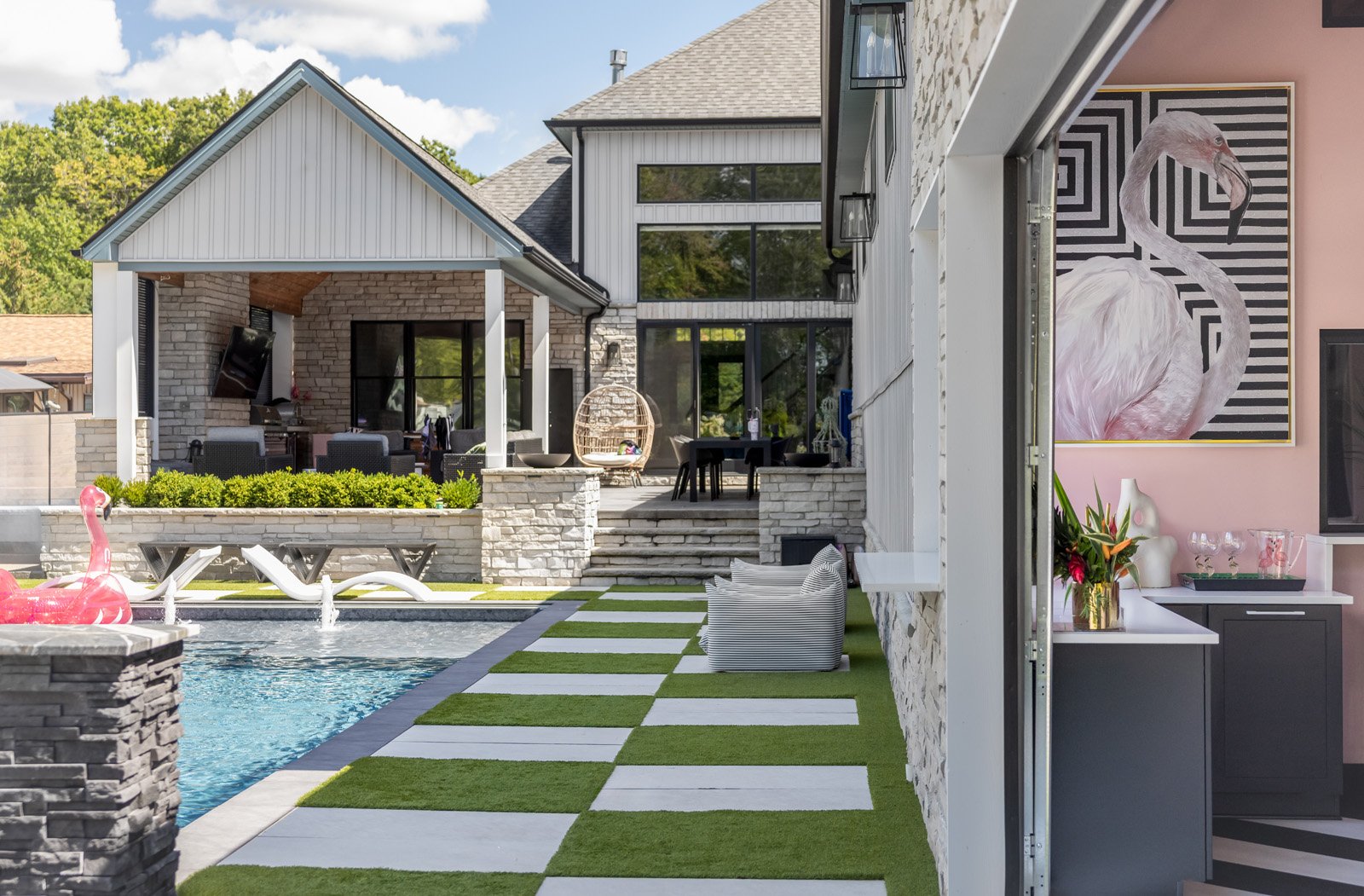
For our clients in Northeast Ohio and in coastal markets like Naples, the outdoor living space is not a seasonal amenity. It is a room (one of the most important rooms in the house) and it must be designed with the same intention, investment, and specificity as everything inside.
We have watched the outdoor living category transform completely over the past decade. The notion that outdoor spaces are somehow secondary to interior spaces (that a nice patio with some weather-resistant furniture constitutes an outdoor room) is simply no longer adequate for the clients we serve. Today’s luxury outdoor living space is a fully equipped, fully designed extension of the home. A room that happens to be outside.
For families who entertain, this space is often where the best moments happen. Where the adults move after dinner on a summer evening. Where kids spend entire weekends. Where the unofficial party continues long after the formal dinner has ended. Where the memory is made.
The Outdoor Kitchen: Non-Negotiable for Serious Entertainers
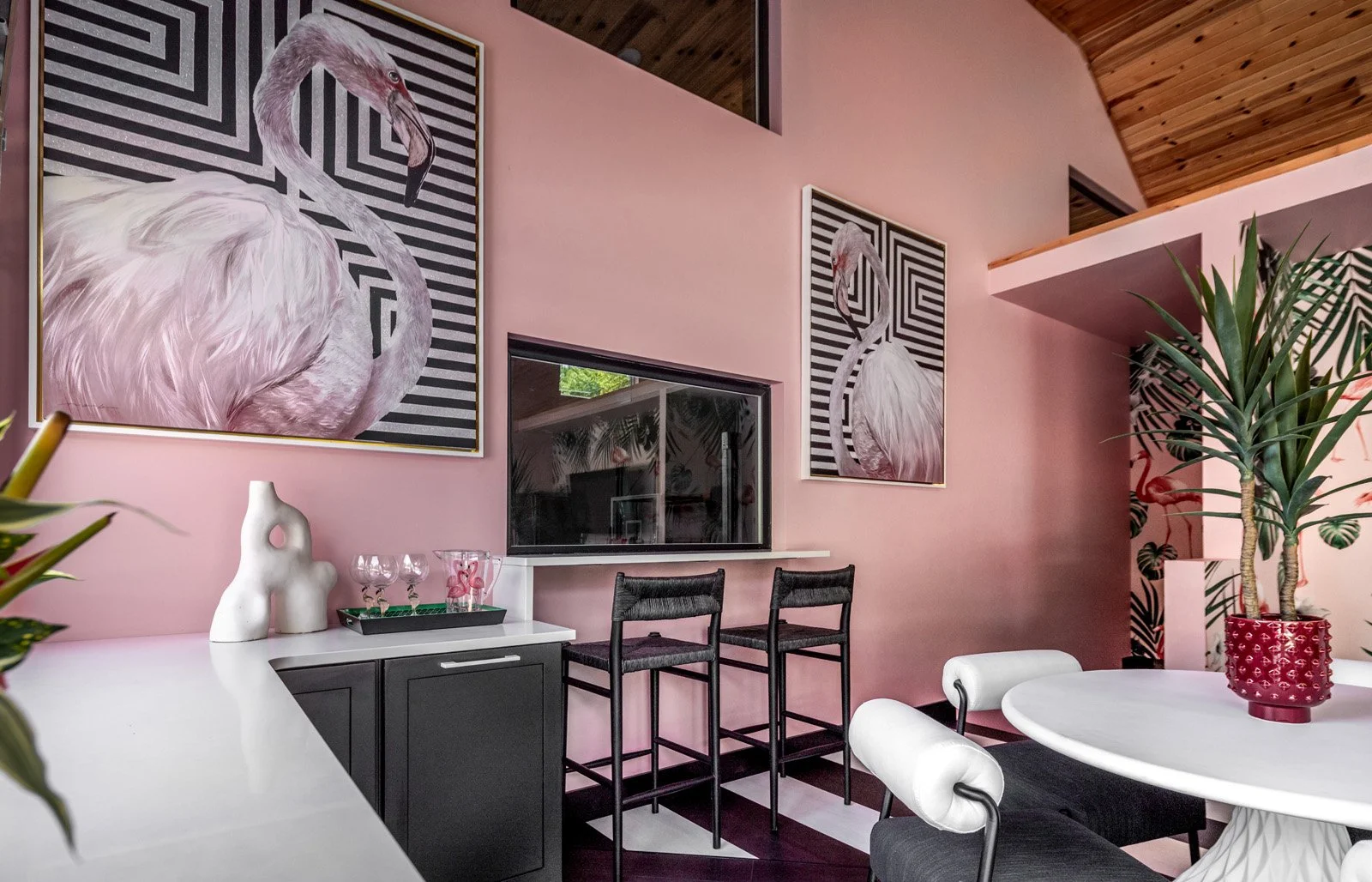
We recommend a fully equipped outdoor kitchen on virtually every entertaining project we take on, and we mean fully equipped — not a grill station with a side burner, but a genuine second kitchen that makes outdoor entertaining as effortless as indoor entertaining.
Professional-grade gas grill with at least 36 inches of cooking surface: we often specify 48 inches for clients who regularly cook for large groups
Dedicated refrigeration, ideally both a standard refrigerator and a dedicated beverage or wine refrigerator
Sink with both hot and cold water: this detail is consistently undervalued and consistently appreciated by every client who has it
A minimum of 8 linear feet of counter space for prep, plating, and staging
Under-counter storage in stainless or powder-coated aluminum that will perform in your specific climate across decades
Overhead ventilation or a location that accounts for smoke and heat management
The materials for an outdoor kitchen must be specified with climate performance as the primary criterion. For Ohio clients, this means materials that handle freeze-thaw cycles, humidity, and UV exposure without degrading. For Florida clients, it means salt air resistance and UV stability across decades. We do not specify outdoor kitchens based on what looks beautiful in a showroom. We specify them based on what will look beautiful in your specific backyard in fifteen years.
The Covered Living Area: Where the Evening Actually Happens
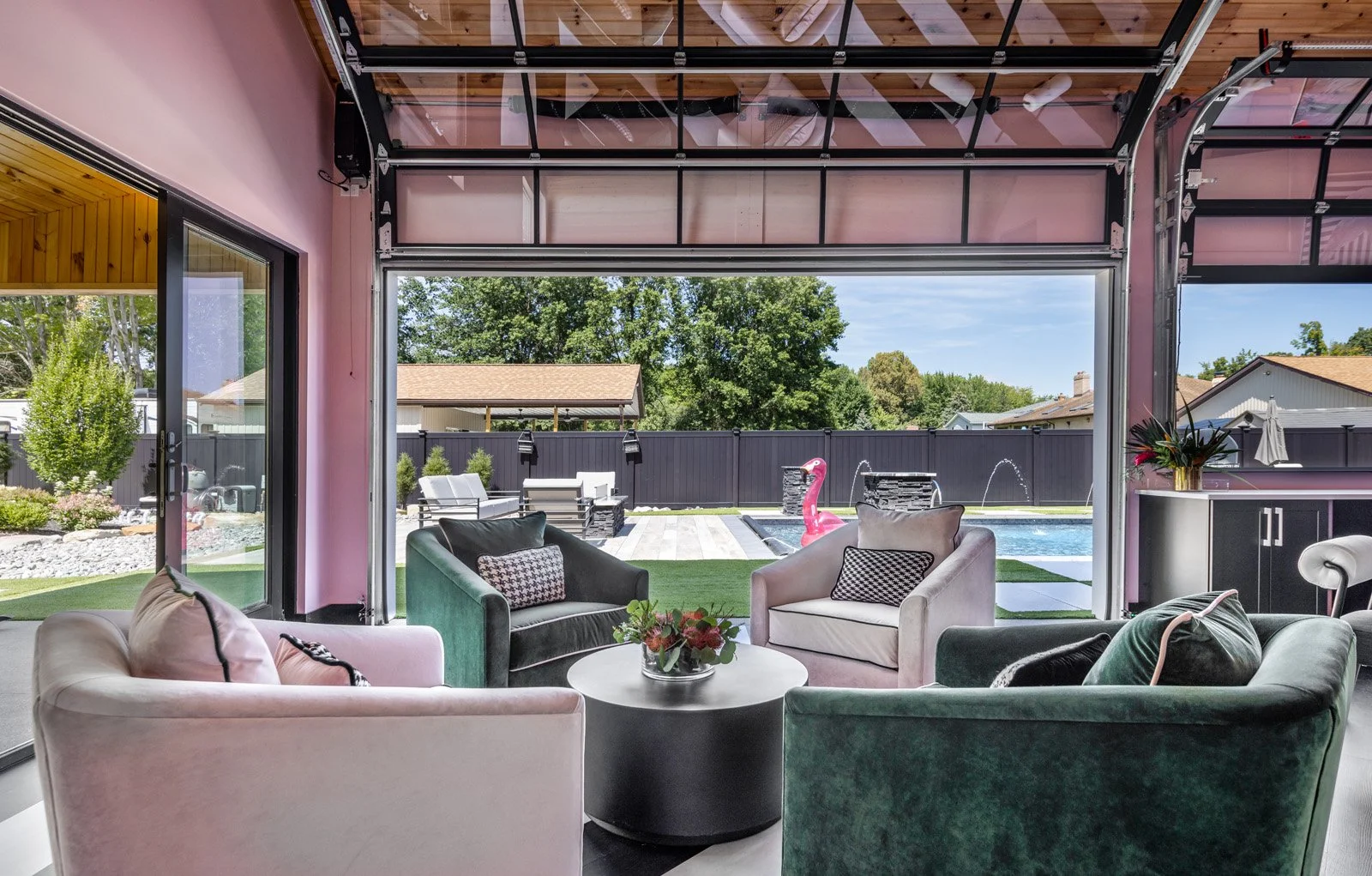
The outdoor kitchen is where it’s at. And the covered living area is where the gathering actually happens: where guests settle in after dinner, where conversations extend past midnight on a summer night, where the space shifts from functional to experiential.
For this space, we are designing a genuine living room that simply happens to be outside. That means:
Generous, genuinely comfortable seating: Upholstered sectionals and lounge chairs in performance outdoor fabrics that are genuinely comfortable, not the thin-cushioned patio furniture that sends everyone inside after an hour. We specify Perennials, Sunbrella, and other outdoor performance fabrics that look and feel like interior upholstery.
A fireplace or fire feature: For most of our clients, this extends the outdoor living season by months. The outdoor fireplace is not decorative. It is the feature that makes October evenings on the terrace possible, that makes early-spring dinners outside work, that gives the space a focal point and a warmth source when the temperature drops.
Overhead heating: Radiant heating panels installed in the ceiling of the covered living area are a detail we recommend consistently. Invisible when not in use, they make shoulder-season outdoor entertaining genuinely comfortable rather than merely possible.
Outdoor audio: Integrated, weatherproof speakers tied to the home’s audio system bring the music outside without the visual clutter of portable speakers. This detail costs relatively little and is used every single time the space is occupied.
Layered outdoor lighting: String lights are not a design choice. They are a placeholder. We design outdoor lighting with the same layered approach we use inside, architectural lighting that illuminates the space, accent lighting that highlights the landscape and the structure, and decorative lighting that creates the feeling of being inside something beautiful.
The Pool: Investment, Intention, and Integration
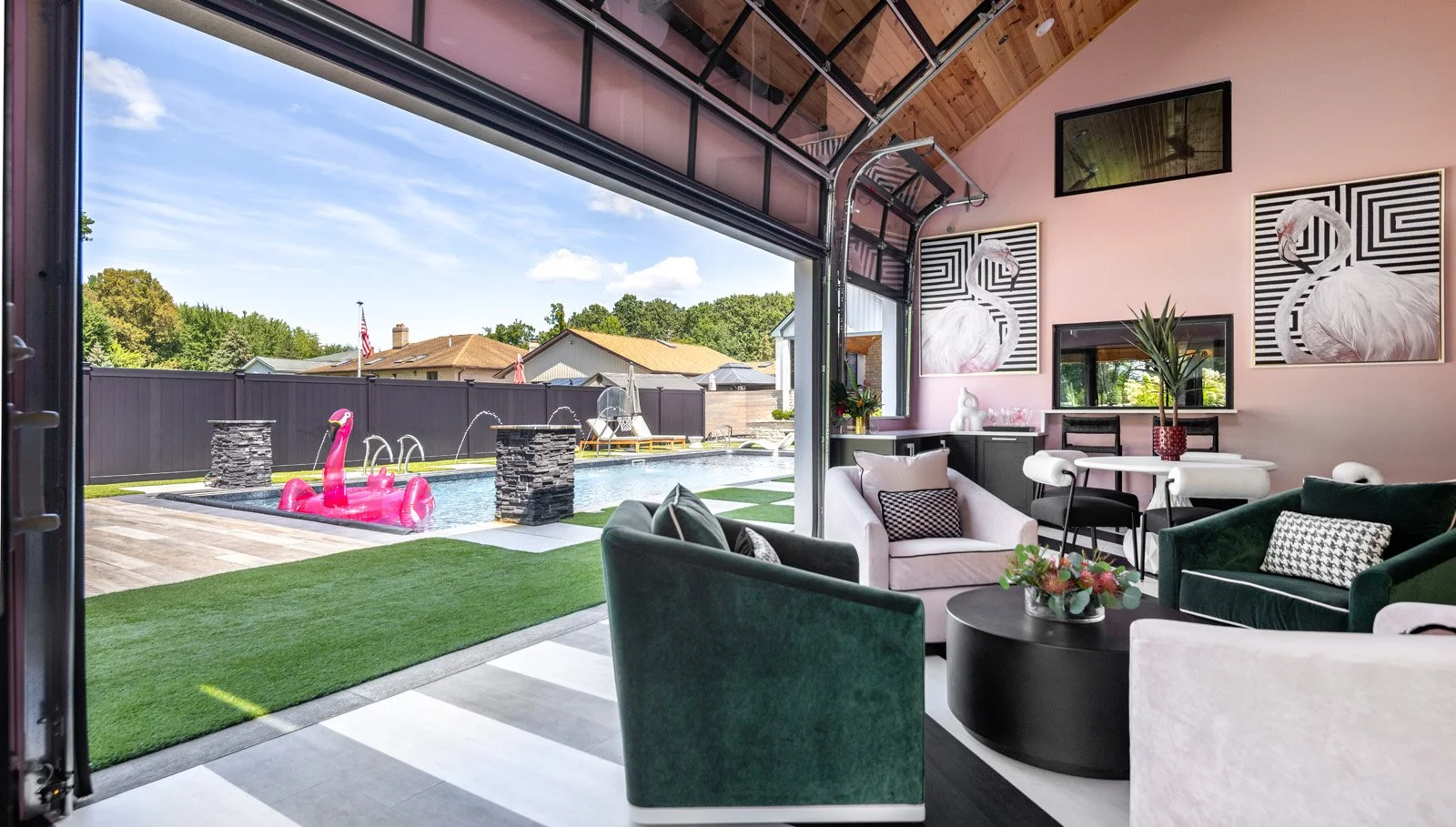
For clients with pools, the pool is not a separate project from the home design. It is part of a unified outdoor experience, and it must be designed in relationship to the architecture, the indoor spaces, and the way the family actually uses the outdoor area.
The questions we ask at the beginning of every pool conversation: Where does the pool sit relative to the outdoor kitchen and living area? Can the adults supervise children from the primary gathering space? What is the sightline from the main interior living areas? Is the pool design complementing the architecture of the home or competing with it? Is there a spa? A tanning ledge? A dedicated children’s zone? A lap lane?
These are not questions about amenities. They are questions about how the pool will integrate into the daily life of the family using it — and the answers shape every decision that follows.
The outdoor living space is not a seasonal amenity. It is a room (one of the most important rooms in the house) and it must be designed with the same intention and investment as everything inside.
Room Five: The Primary Suite: The Room That Is Entirely Yours
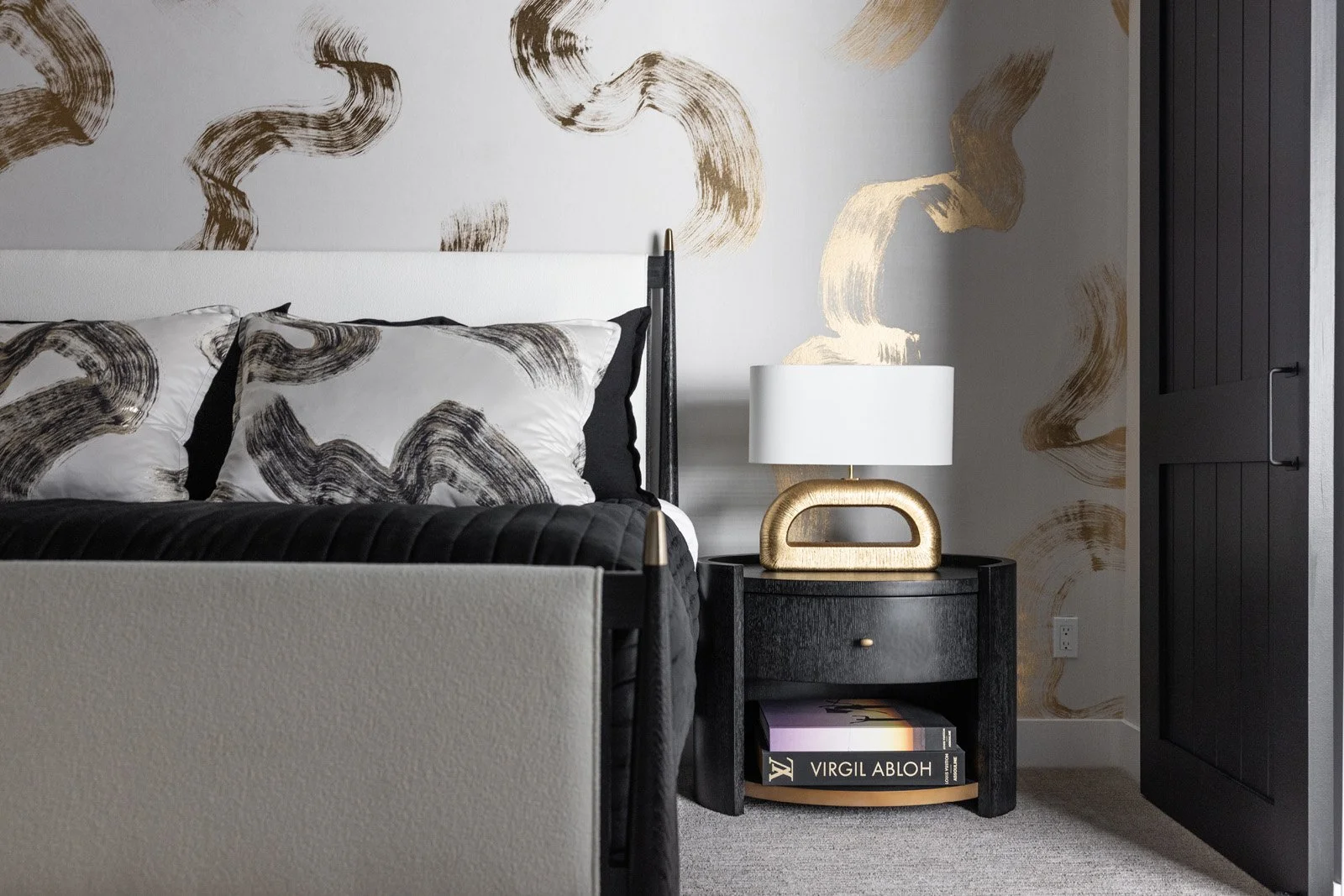
Every room we’ve discussed so far is, in some sense, about other people. The kitchen serves your guests. The great room holds your gatherings. The outdoor space extends your entertaining. Even the powder bath performs for visitors.
The primary suite is the one room in the house that is entirely and exclusively yours.
This is the room that most directly determines the quality of your daily life. It is where you begin and end every day. It is where you retreat from the demands of work, family, and social life, where you decompress, recharge, and restore. For our most dedicated entertainers, clients whose social lives are genuinely rich and full and wonderful, the primary suite is not a luxury. It is a necessity. It is the sanctuary that makes the rest of the home possible.
We design primary suites with a single guiding principle: this space must feel like the finest hotel room you have ever stayed in, but warmer, more specific, and entirely yours.
The Bedroom: Sanctuary Architecture
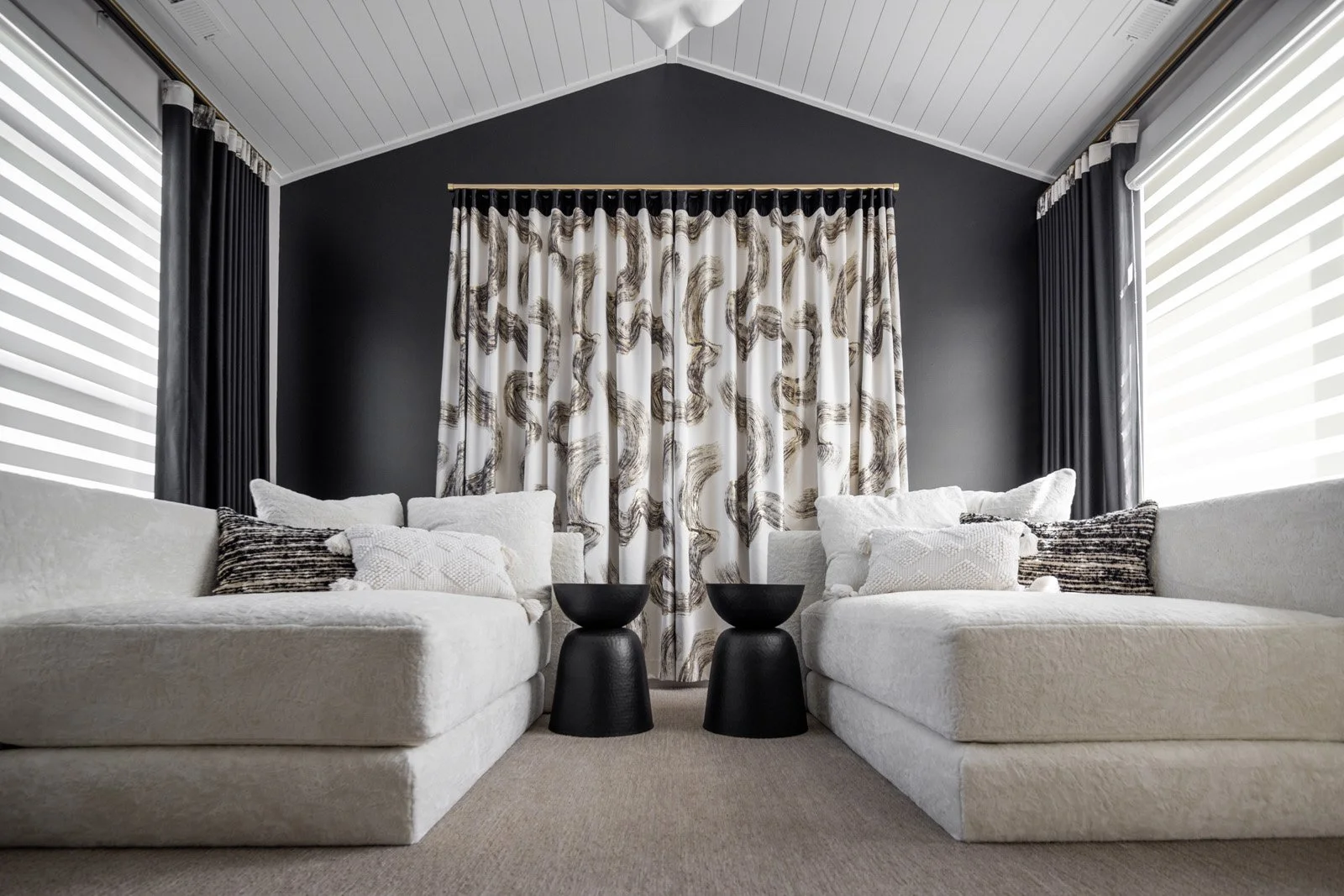
The bedroom is a room designed for two specific experiences: sleeping and waking. Every design decision we make serves those two experiences.
The bed wall is the starting point. We design it as an architectural moment, a custom upholstered headboard that extends to the ceiling, flanked by integrated nightstand cabinetry with thoughtful storage, perfect reading light, and concealed charging. The headboard is often the most important piece of furniture in the home. It establishes the scale, the color direction, and the feeling of the entire room. We spend considerable time getting it right.
Window placement and window treatments are critical in the primary bedroom in ways that differ from the rest of the house. Blackout capability is non-negotiable for quality sleep, we almost always specify motorized shades with blackout lining behind drapery panels, on a timer or integrated with the smart home system. The drapery panels themselves are purely decorative: pooling slightly on the floor, in a fabric that contributes to the room’s softness and warmth.
Ceiling height matters more in the primary bedroom than almost anywhere else. An eight-foot ceiling limits what is possible. We work with architects from the earliest stages of a project to prioritize ceiling height in the primary suite (ideally ten feet or higher) because the proportions of a well-scaled bedroom communicate luxury before a single finish has been selected.
And always, without exception, we layer the lighting. The primary bedroom should never be lit by a single overhead fixture. We design circuits for ambient light, accent light, reading light at the bedside, and a soft, low-level night circuit. Every circuit on a dimmer. The room should be able to feel like morning, like afternoon, like evening, and like sleep, with the adjustment of a single scene on a bedside panel.
The Primary Bath: Where Luxury Is Felt Every Single Day
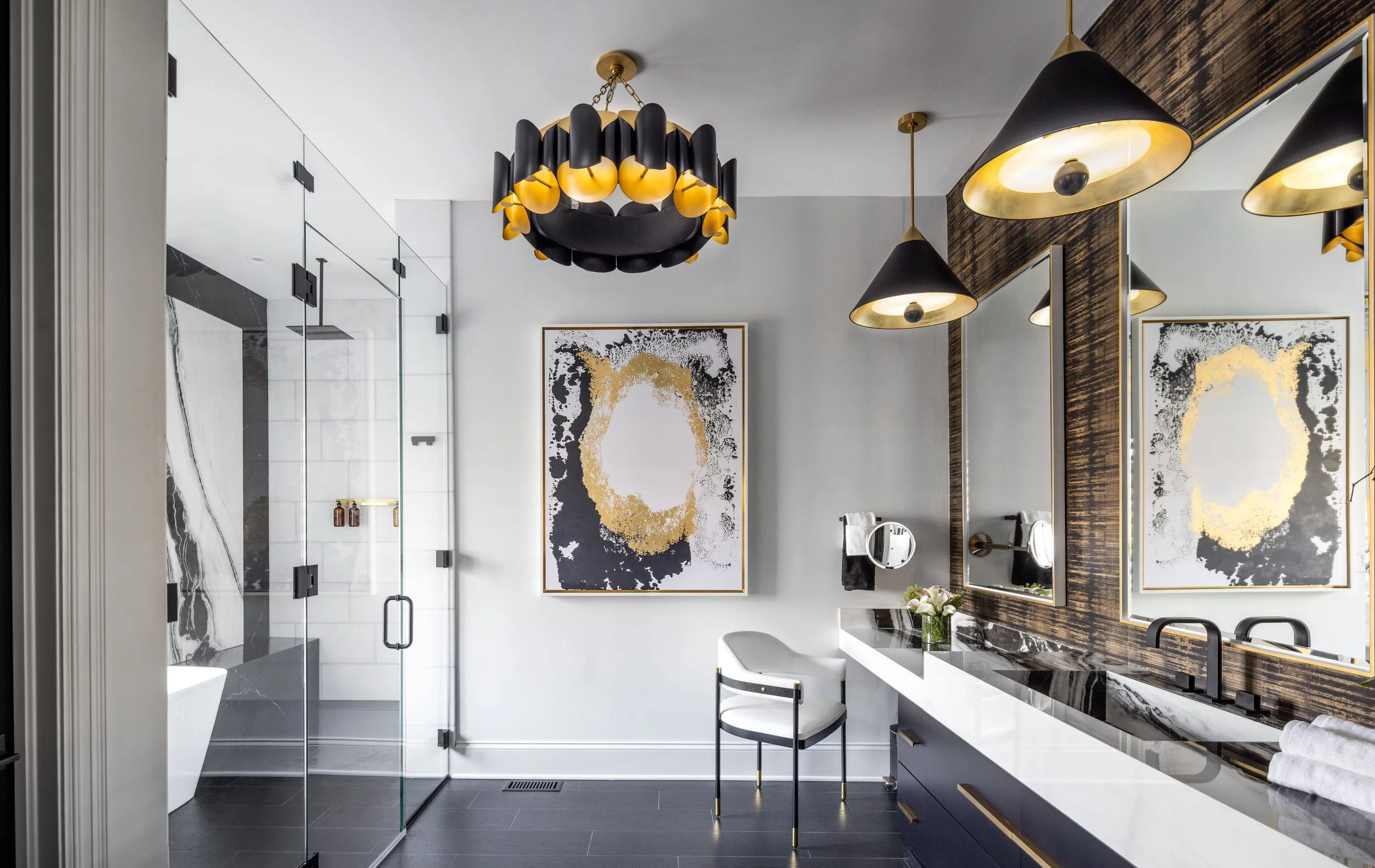
If there is one room in the entire house where we consistently recommend spending more than feels comfortable, it is the primary bath. Not because it is the most important room, but because it is the room where the investment in quality is felt most acutely, most repeatedly, over the entire life of the home.
You use this room every morning and every evening. For the rest of your life in this house. The return on an exceptional primary bath — measured in daily quality of experience, not resale value, is among the highest of any investment you can make.
The shower: Larger than you think you need, and then larger still. A minimum of 4 by 5 feet for a functional luxury shower, and 5 by 7 or larger for a shower that genuinely transforms the experience of getting ready. A full rain fixture overhead, a handheld, and a body spray system. A linear drain that allows for a curbless, frameless entry. Bench seating built into the structure. Steam capability, if the clients have any interest in a daily spa experience, and most of our clients, once they experience it, wonder how they lived without it.
The soaking tub: The freestanding soaking tub is a design statement, a bathing experience, and a room anchor all at once. We almost always specify one in the primary bath, positioned intentionally, under a window, in a defined niche, in a position that creates a natural focal point. The tub does not need to be used daily to be worth the investment. It is a luxury experience that your home provides, available whenever you want it.
Heated floors: This detail costs relatively little to install during construction and is used every single morning for the rest of the time you live in this home. Stepping onto a warm floor on a cold morning is not a minor pleasure. It is the kind of daily experience that makes a home feel like a sanctuary rather than simply a house.
The vanity: Custom cabinetry at the vanity is worth every penny in the primary bath. The storage must be designed around how the specific people using it actually store their things. The drawer configuration, the electrical outlets inside the cabinet, the magnifying mirror on an extension arm, the built-in organizers for jewelry and cosmetics, all of it designed to make the morning routine effortless.
Materials: The primary bath is one of the rooms where we most often recommend genuine stone: book-matched marble or quartzite slabs that carry through from floor to wall to shower, creating visual continuity and the unmistakable quality that only natural stone provides. The result is a room that grows more beautiful with age, not less.
The Walk-In Closet: A Room, Not an Afterthought
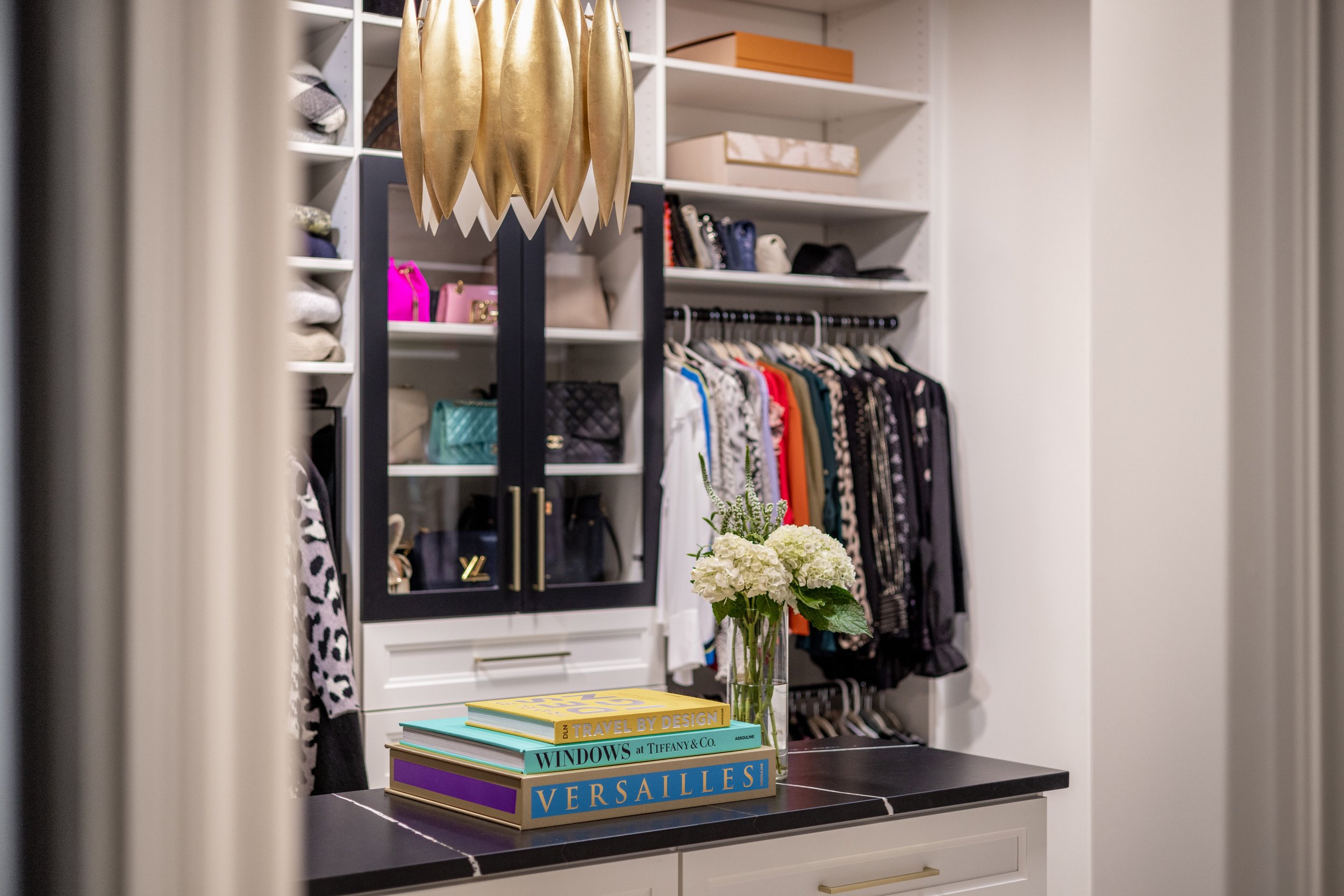
For our clients, the walk-in closet is a room, often one they spend significant time in daily, a room that must function as beautifully as it looks, and a room that must be designed around the specific wardrobe and lifestyle of the people using it.
We approach closet design as a deeply personal exercise. Before we specify a single inch of storage, we understand exactly what is being stored: suits and formal wear, casual and weekend clothing, a significant shoe collection, fine jewelry, handbags, athletic wear, travel gear. We design specific storage for every category, in the quantities required, organized according to how each client actually thinks about their wardrobe.
The details that separate a well-designed closet from an extraordinary one: integrated lighting that illuminates every section without casting shadows on clothing; a central island with deep drawers for folded items and a glass-topped jewelry section; full-length mirrors positioned for complete visibility; a seating area, even if just a single upholstered bench, for putting on shoes; dedicated space for luggage; and an electrical plan that supports the steamer, the heated jewelry cabinet, and the phone charging that happen in this room every day.
The closet is finished with the same materials and attention as the rest of the primary suite. Wallcovering, painted millwork, hardwood or tile flooring, statement lighting, the closet is not a utilitarian space with a nice cabinet system. It is a room in the fullest sense.
The primary suite must feel like the finest hotel room you have ever stayed in, but warmer, more specific, and entirely yours. This is the room that determines the quality of your daily life.
The Thread That Connects All Five Rooms
If you’ve read this far, you’ve noticed something: these five rooms are not designed in isolation. They are designed in relationship to each other, to the family living inside them, and to the specific life being lived in this specific home.
The kitchen flows to the great room, which opens to the outdoor living space, which becomes the destination after dinner. The primary suite is the retreat that makes the full, rich social life of the rest of the home sustainable. The powder bath is the detail that tells every guest who you are before they even make it to the living room.
This is what comprehensive, full-home design actually means. It is not room-by-room decision-making. It is orchestrated thinking about how a home functions as a unified whole, how every space serves the life being lived inside it, how the flow from room to room feels effortless and intentional, how the materials and finishes and lighting and hardware all speak the same visual language.
This kind of thinking cannot be applied to a single room. It cannot be retrofitted after construction. It must be established from the very beginning of a project, from the earliest conversations between the family and the design team, from the first time someone asks: How do you actually live? And what does your home need to make that life as beautiful and as effortless as possible?
Those are the questions we ask on every project we take on. They are the questions we have been asking for over a decade.
The result is homes that work as exquisitely as they look. Homes that are still beautiful, and still working beautifully, twenty years after the day we handed over the keys. Homes that our clients call the best investment they ever made — not because of what they are worth on paper, but because of what they are worth in daily life.
What It Looks Like to Work With Adeas Interior Design

We are a sister-run design firm based in Cleveland, Ohio. We work exclusively on full-home design, custom builds and complete renovations. We take only a limited number of clients per year, which allows us to be fully present and fully invested in every project we accept.
Summer brings fearless creative vision and a nursing background that translates, more than you might expect, into an extraordinary ability to listen, to understand what people actually need, not just what they think they want. Serena brings meticulous operational expertise, a CPA’s precision for budget and process, and the systems that ensure every project runs as beautifully behind the scenes as it looks in the finished rooms.
Together, we lead every project from the initial discovery conversation through the final installation reveal. You work with us, not with a junior designer, not with a project assistant who relays information back and forth. With us, directly, throughout the entire process.
Our process unfolds across five phases:
Discovery and Consultation: We begin by understanding you: your lifestyle, your family, how you actually live in your home, what you love and what you have always wanted. This is not a questionnaire exercise. It is a genuine conversation, typically spanning multiple sessions, that shapes every design decision that follows.
Concept and Design Development: We develop the full creative vision for your home: from architectural coordination and space planning through material selection, custom millwork design, furniture specification, and 3D visualization. You see your home before a single wall is built.
Documentation and Implementation: Our design plans become comprehensive construction documents: typically 40 to 60 pages for a full home, that specify every detail precisely. This documentation is what allows builders to execute our vision with exactness, and it is what prevents the costly change orders and construction errors that plague projects without rigorous documentation.
Project Management: We are on-site weekly throughout construction, coordinating all trades, inspecting every installation, catching every issue before it becomes a problem you have to live with. You receive weekly status updates. You are never surprised.
Installation and Reveal: Installation day, or days, for larger projects, is when your home comes to life. We coordinate every delivery, every placement, every last detail. We make the beds with freshly laundered linens. We set the coffee to brew. We arrange the books, the flowers, the objects that make a house feel like home. And then we invite you to walk through the door for the first time.
That last detail: the coffee brewing, the linens turned down, the small, specific gestures that say we thought about this moment, is not marketing language. It is what we actually do, on every single project, because we believe that the experience of arriving in your new home for the first time should be as extraordinary as the home itself.
We make the beds. We set the coffee to brew. We arrange the flowers. Because the experience of arriving in your new home for the first time should be as extraordinary as the home itself.
Is This You?
Our clients are building or renovating significant homes, and they share a few things in common:
They want a home that serves their full life: their family, their entertaining, their daily ease and long-term joy, not just a home that photographs beautifully.
They do not have the time, the expertise, or the desire to manage a complex design and construction process. They want a partner who handles it completely, who they can trust absolutely, and who will protect their investment and their peace of mind from start to finish.
They understand that exceptional design is a significant investment, and they are ready to make that investment because they understand what it returns, in the daily quality of the life they will live in their home.
They want to be involved in the creative experience, to see their vision come to life, to make the decisions that matter most to them without having to manage the process. They want to enjoy the journey, not work it.
If that sounds like you, we would love to have a conversation.
We take four clients per year. That limit is intentional. It is how we ensure that every client receives our complete focus, our full expertise, and the level of personal attention that makes the difference between a beautiful home and an extraordinary one.
If you are considering a project in 2026 or 2027, now is the strategic time to connect, not because of artificial urgency, but because beginning the design conversation early allows us to coordinate with your architect during the design phase, get long-lead custom elements into production ahead of schedule, and ensure you have the timeline and attention your project deserves.
The five rooms we’ve covered in this guide, the kitchen, the great room, the powder bath, the outdoor living space, and the primary suite, are the foundation of an entertaining home that truly works. But they are just the beginning of the conversation.
Every home we design is specific to the family living inside it. The details that matter to you: the way you host, the way you live, the experiences you want your home to provide, are the details that shape every decision we make. There is no formula. There is no template. There is only your life, and a design team completely committed to building a home around it.
